
We asked senior IT and business decision makers / influencers about their most recent purchase of a complex, high value solution.* We wanted to know who won the business. Nearly 2/3 (59%) of the respondents indicated that they awarded the bid to the incumbent.
But that’s just the beginning of the story. A mere four years ago, in 2018, more than ¾ of the time (77%), the incumbent would win.
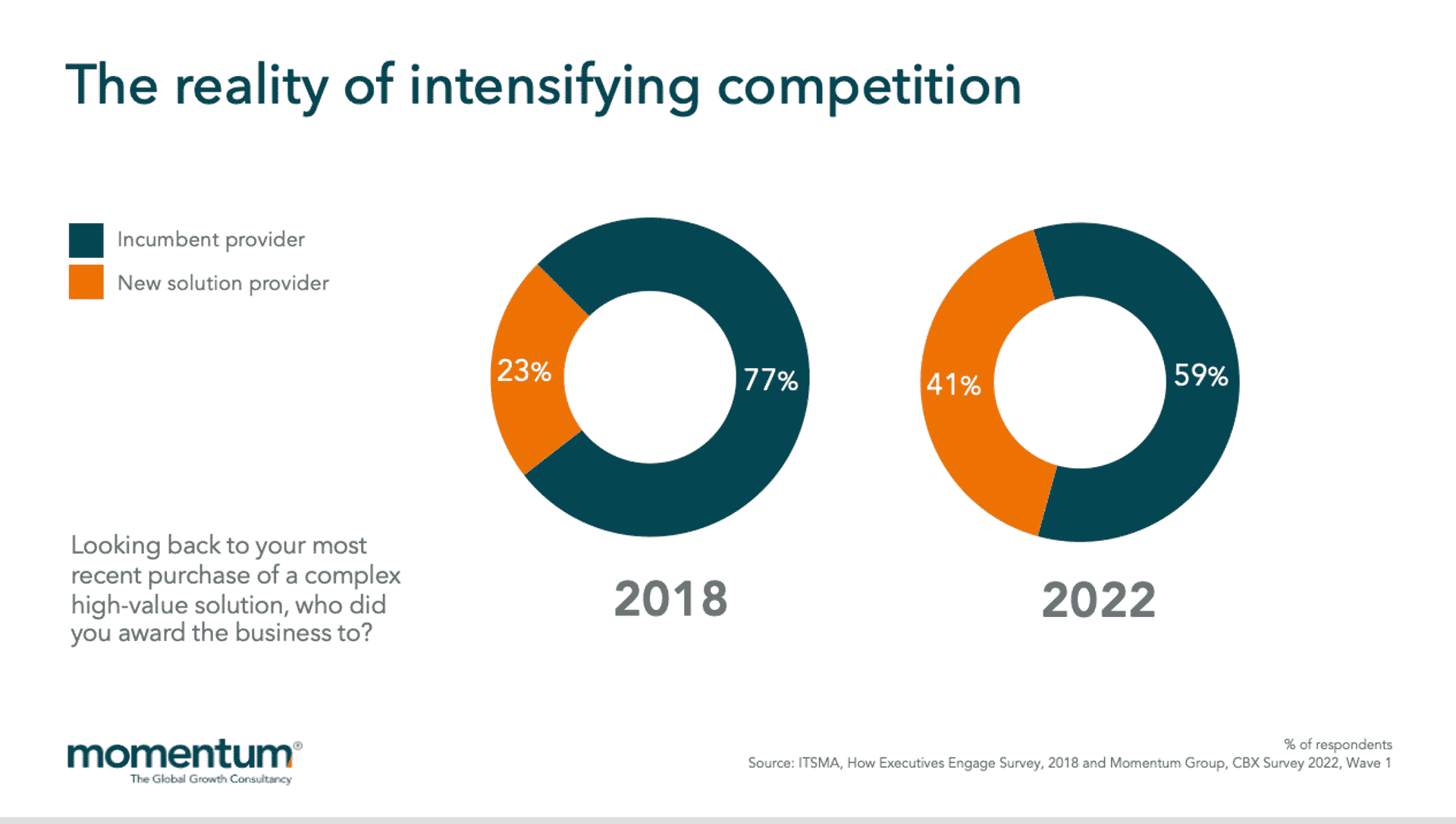
This is a fairly dramatic shift in loyalty. Large enterprise accounts may no longer be giving incumbent solution providers the benefit of the doubt. Instead, they are much more open to new providers and significantly less likely to default to the incumbent.
This has important implications for all solutions providers, whether you’re looking at establishing or deepening relationships with a company.
First, if you are the incumbent, you cannot rest on your laurels. You need to know there’s serious competition out there and you may need to need to work twice as hard to retain and grow existing accounts.
On the flip side, this means there may be some great opportunities to win new accounts. Again, you have to work hard and prove your worth – but, at least now, your targets are willing to listen.
While we did not survey buyers about why they chose either the new or incumbent solution provider, subsequent conversations with clients have shed some light on the shift.
First, buyers may be focusing on new types of solutions and the incumbent may not have the capabilities to deliver.
Another insight is that buyers are often spending differently on different types of solutions given all the disruption of recent years coupled with the business’s “innovation imperative” Sometimes this means they’re required to look beyond incumbents, even if they are relatively satisfied with them.
What can solution providers do?
If you are the incumbent, you need to re-assess the strategies you have in place to protect and grow your existing accounts. Your focus should be on doubling down on your installed base. You may need to look at new solution innovation while also focusing on marketing and sales.
If you’re chasing new logos, then you might need to re-calibrate your strategies to capitalize on new opportunities. Your marketing and sales need to be targeted and relevant.